Air Purifier Price Breakdown: Budget vs Premium Models Compared
Indoor air quality has become a mainstream concern, not just for health-conscious buyers but for anyone living in urban areas where pollution levels frequently cross 150 on the Air Quality Index (AQI). With so many air purifiers or air cleaners available today, one of the first questions consumers ask is, “What should I realistically expect to pay?” The answer is not just about the sticker price, but about understanding why models cost what they do and how that impacts long-term ownership.
What Determines the Price of an Air Purifier?
Before looking at budget and premium categories, it helps to understand the factors that directly influence pricing.
-
Filtration Technology
True HEPA H13 filters, capable of capturing particles as small as 0.1 microns, cost more than basic filters. Higher-end models often combine HEPA filtration with activated carbon, plasma, or UV-based systems to tackle odours, gases, and finer pollutants.
-
Build Quality and Components
Premium air purifiers typically use quieter motors, better seals, and more durable materials. Budget models focus on basic airflow and filtration, often using simpler fans and lightweight housings.
-
Coverage Area and CADR
Air purifiers designed for larger rooms require stronger motors and larger filters to deliver higher Clean Air Delivery Rates (CADR), which directly impacts pricing.
-
Brand and After-Sales Support
Established brands often price higher due to warranties, reliable service networks, and consistent product performance.
With these factors in mind, the differences in air purifier prices become easier to understand.
Budget Air Purifiers: Cost and What You Get
Budget air purifiers are well-suited for first-time buyers, small apartments, or individual rooms. In India, entry-level models typically fall between ₹4,000 and ₹12,000. Most offer a single-stage or dual-stage filtration system using HEPA and activated carbon, which is sufficient for removing common indoor pollutants like dust, pollen, and PM2.5 in smaller spaces.
A good example in this category is the Forbes 150 Surround 360° Air Purifier. Designed for rooms up to 200 sq. ft., it uses a 3-stage filtration system with a pre-filter, activated carbon filter, and True HEPA H13 filter. Its 360° air intake allows it to draw in pollutants from all directions, making it a practical option for bedrooms or single-occupant homes without a high upfront cost.
Pros of Budget Models
- Affordable initial investment
- Lower electricity consumption
- Ideal for bedrooms and compact living spaces
Cons to Consider
- Filter replacements can add up over time
- Limited coverage may require multiple purifier units for larger homes
Premium Air Purifiers: What You’re Paying For
Premium air purifiers generally start around ₹13,000 and can exceed ₹60,000, with commercial-grade models priced even higher. These units are built for larger areas and daily use, offering advanced features such as multi-stage filtration, smart sensors, real-time air quality monitoring, and quieter operation.
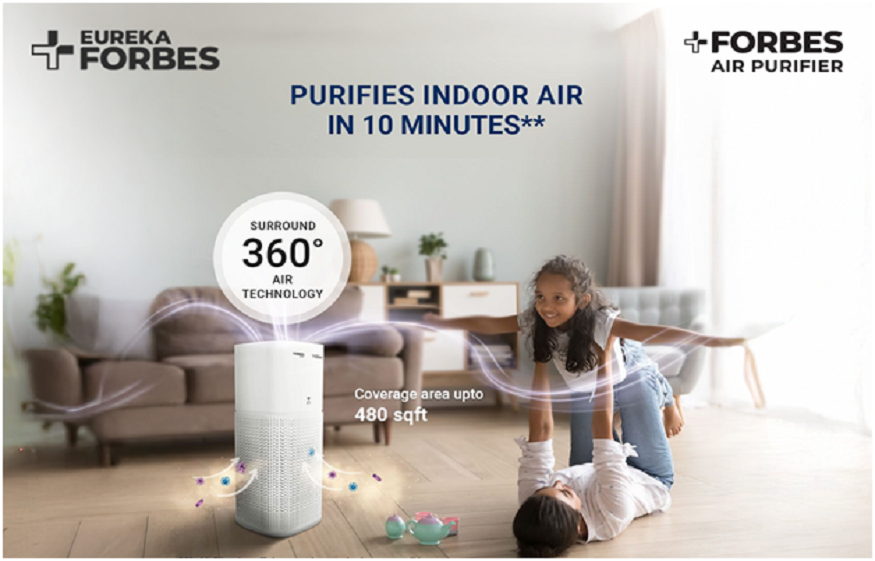
For medium to large living spaces, the Forbes Smart 500 Surround 360° Air Purifier fits squarely into this category. It covers up to 670 sq. ft. and includes smart app control, sleep mode, and faster purification speeds, capable of cleaning indoor air in about 10 minutes under standard conditions. In addition to a pre-filter, activated carbon, and True HEPA H13 filter, it also uses plasma filtration, making it suitable for family homes and high-usage environments.
Pros of Premium Models
- Stronger and more consistent air purification
- Better performance for allergies and sensitive users
- Quieter operation and longer filter life
Cons to Consider
- Higher upfront cost
- Replacement filters can typically be more expensive
Choosing What’s Right for You
The right air cleaner depends on your space and usage needs:
- Small rooms or occasional use: A budget or entry-level model is usually sufficient.
- Larger rooms or daily use: A mid-range or premium purifier offers better long-term value.
- Health-focused households: Advanced filtration and smart monitoring can make a noticeable difference.
By understanding the real cost drivers behind budget and premium air purifiers, you can make a well-informed decision that balances price, performance, and long-term value, rather than choosing solely based on the lowest price tag.
Order Tramadol Online
Buy Hydrocodone Online Overnight
Buy Online Soma
Buy Lorazepam Online Without Prescription
Purchase Xanax Without Prescription
Buy Prednisone Online Without Prescription
Buy Tramadol 100 Mg Online
Buy Clonazepam Without Prescription
Buy Klonopin Online Overnight